Category Archives: Research

Talk: Contingentist sets as potentialist properties

Philosophy of Mathematics Seminar, Oxford, 2024

Philosophers who take being to be contingent face a problem involving sets of possibilia. Semantic reflection gives contingentists a powerful motivation to posit sets with non-actual members or even sets with incompossible members. On the other hand, good metaphysics assures us that there are no such sets. This talk outlines an interpretation of set theory based on a potentialist theory of properties that permits ‘sets’ with non-actual or incompossible members. This provides a way, I argue, for contingentists to meet the needs of semantics without resorting to bad metaphysics.

Talk: Type-theoretic potentialism

Actualism and Potentialism: Konstanz 28th September 2023

There has been recent interest in intensional type theory, both as a framework to tackle metaphysical questions about modality, propositions, properties, and so on (e.g. Bacon and Dorr, ‘Classicism’) and as an alternative to set theory as a foundation of mathematics (e.g. Goodsell and Yli-Vakkuri, Logical Foundations). These type theorists typically adopt an ‘actualist’ attitude towards the type-theoretic hierarchy: quantifiers in each type are assumed to range over absolutely every entity of the appropriate type (e.g. type e quantifiers range over absolutely every individual). This talk considers a ‘potentialist’ alternative, which permits entities of arbitrary type to be nominalized as new individuals.  

Talk: Caesar and Stipulation

Abstractionism 2: UConn, 12th August 2023

A neglected response to the Caesar problem maintains that the content of ‘mixed’ identity contexts such as ‘#X = Julius Caesar’ is just as open to stipulation as the content of ‘unmixed’ contexts such as ‘#X = #Y’. I defend this stimulative response against some objections, including those raised by Fraser MacBride and by Bob Hale and Crispin Wright.

Article: The Caesar Problem — A Piecemeal Solution

Philosophia Mathematica 31(2) 2023: https://doi.org/10.1093/philmat/nkad006

The Caesar problem arises for abstractionist views, which seek to secure reference for terms such as ‘the number of Xs’ or #X by stipulating the content of ‘unmixed’ identity contexts like ‘#X = #Y’. Frege objects that this stipulation says nothing about ‘mixed’ contexts such as ‘#X = Julius Caesar’. This article defends a neglected response to the Caesar problem: the content of mixed contexts is just as open to stipulation as that of unmixed contexts.

Linnebo’s abstractionism and the bad company problem

Early View of the Special Issue of Theoria on Linnebo’s Thin Objects: https://doi.org/10.1111/theo.12356

Abstract: In Thin Objects: An Abstractionist Account, Linnebo offers what he describes as a “simple and definitive” solution to the bad company problem facing abstractionist accounts of mathematics. “Bad” abstraction principles can be rendered “good” by taking abstraction to have a predicative character. But the resulting predicative axioms are too weak to recover substantial portions of mathematics. Linnebo pursues two quite different strategies to overcome this weakness in the case of set theory and arithmetic. I argue that neither infinitely iterated abstraction nor abstraction on possible specifications fully resolves the bad company problem.

Infinite Types and the Principle of Union

Nicolai and Stern, eds., Modes of Truth. The Unified Approach to Truth, Modalities, and Paradox (Taylor and Francis, 2021)

Abstract: In addition to objects (i.e. entities of type 0) should we also believe in entities of other types? Are there also type 1 entities (e.g. first-level Fregean concepts, pluralities), and type 2 entities (e.g. second-level Fregean concepts, superpluralities), and so on? Øystein Linnebo and Agustín Rayo argue that ‘plausible’ assumptions lead to a surprising conclusion for those who accept that first-order quantifiers may range over absolutely every object: absolutists of this kind should countenance proper-class-many types. This chapter takes up their argument for this thesis—Infinite Types—and argues that one of its assumptions is rather less plausible than Linnebo and Rayo suggest. The problematic assumption is the Principle of Union which states that one should countenance any language which ‘pools together’ the expressive resources drawn from any set of languages already deemed legitimate.

Open access to the book here: https://library.oapen.org/handle/20.500.12657/47577

Hybrid relativism and revenge

 
Workshop: Semantic Paradox, Context, and Generality
June 26-28, 2019, University of Salzburg

Abstract: Absolutism about quantifiers is the view that quantifiers sometimes range over an absolutely comprehensive domain. Relativists about quantifiers often oppose this view on the grounds that concepts such as set are ‘indefinitely extensible. To assuage doubts about the coherence of this view, relativism and the argument from indefinite extensibility may be regimented with the help of ‘modalized quantifiers’. But what is the status of these putatively relativist-friendly generalizing devices? Some relativists may be tempted to combine their quantifier-relativism with a species of absolutism about modalized quantifiers. I argue that this hybrid view faces a revenge problem.

See also: Everything, More or Less, §7.5

Slides [.pdf, new tab]

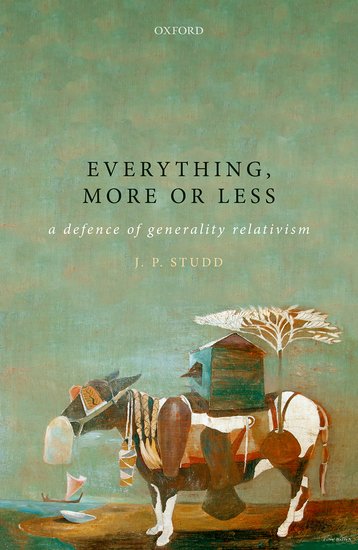
Everything, more or less

Almost no systematic theorizing is generality-free. Scientists test general hypotheses; set theorists prove theorems about every set; metaphysicians espouse theses about all things regardless of their kind. But how general can we be and do we ever succeed in theorizing about absolutely everything? Not according to generality relativism.

In its most promising form, this kind of relativism maintains that what ‘everything’ and other quantifiers encompass is always open to expansion: no matter how broadly we may generalize, a more inclusive ‘everything’ is always available. The importance of the issue comes out, in part, in relation to the foundations of mathematics. Generality relativism opens the way to avoid Russell’s paradox without imposing ad hoc limitations on which pluralities of items may be encoded as a set. On the other hand, generality relativism faces numerous challenges: What are we to make of seemingly absolutely general theories? What prevents our achieving absolute generality simply by using ‘everything’ unrestrictedly? How are we to characterize relativism without making use of exactly the kind of generality this view foreswears?

This book offers a sustained defence of generality relativism that seeks to answer these challenges. Along the way, the contemporary absolute generality debate is traced through diverse issues in metaphysics, logic, and the philosophy of language; some of the key works that lie behind the debate are reassessed; an accessible introduction is given to the relevant mathematics; and a relativist-friendly motivation for Zermelo-Fraenkel set theory is developed.

Chapter 1 [pre-print]

This is a draft of a chapter/article that has been accepted for publication by Oxford University Press in the forthcoming book Everything, More or Less by James Studd due for publication in 2019.

Update: the book has now been published! OUP website